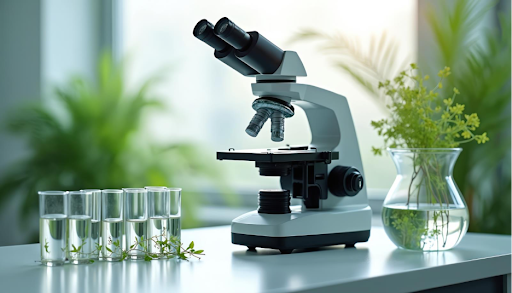
There is a particular moment familiar to anyone who studies plants – a moment when something subtle, almost unspoken, shifts in your understanding. A leaf pattern that once looked decorative suddenly reveals a survival strategy. A color gradient on a petal stops being “pretty” and becomes a chemical signal to pollinators. The longer you study plant systems, the more you realize that the natural world hides its intelligence in plain sight. The real challenge is learning how to see it.
And today, that challenge feels different. Technology hasn’t replaced observation, but it has added entirely new layers to it. Tools that once belonged only to climate scientists, aerospace engineers, or data analysts have quietly taken their place beside botanical field notebooks and soil cores. Even practitioners like DJ Nurre – deeply rooted in traditional ecological study, have found themselves standing at a crossroads where plant biology intersects with machine intelligence, satellite imaging, and advanced modeling.
The change isn’t in style. It’s about structure. Botanical science is no longer limited by what the human eye can see. Instead, it is defined by how many dimensions we can look at the same time.
Seeing What Was Once Impossible to Notice
Plants move, respond, defend, and communicate in ways that evade everyday perception. Time may feel slow for us, but for a plant, growth is its form of motion. What technology has done, particularly time-lapse imaging, hyperspectral cameras, and microscopic sensors, is give shape to behaviors that once felt invisible.
Now, time-lapse imaging shows that root systems act like quiet builders, carefully mapping their surroundings and changing their paths. Stress reactions can be seen in hyperspectral images hours or days before a leaf turns yellow. And tiny sensors inside the roots keep an eye on the flow of water and nutrients with the accuracy of a health monitor.
These technologies don’t simply “add detail.” They change the scale at which scientists can ask questions. Instead of wondering whether drought affects a species, researchers can model how the first six hours of water loss change the plant’s internal chemistry and how that chemistry influences ecological outcomes downstream.
AI and Pattern Recognition: The New Field Assistant
In every ecosystem, patterns tell the story. Plants cluster in certain soil types, evolve matching strategies with local insects, and demonstrate stress in recognizable sequences. The difficulty has always been the sheer volume of variables at play.
Machine learning has shifted that burden.
AI models can now look at plant traits, environmental factors, evolutionary markers, and morphological differences in ways that a single researcher would not be able to do. What used to take several seasons of field observations can now be studied in just a few hours, and the subtleties that make up botanical systems are still there.
The edge isn’t just speed. It makes sense.
AI exposes relationships that would otherwise dissolve into background noise:
- The micro-climate where native plants thrive despite regional decline
- The early-warning patterns of invasive spread
- The soil signatures linked to biodiversity hotspots
The purpose is not to take intuition out of research but to give intuition better material to work with.
Satellite Imaging and the Rise of Large-Scale Ecological Insight
Botany has traditionally been a ground-level science. Leaves, stems, roots, soils – everything happened within arm’s reach. Today, the narrative stretches into the stratosphere.
Forest canopies, grassland transitions, riparian corridors, and desertification can now all be tracked in real time by satellite imaging. This lets scientists keep an eye on changes in ecosystems across continents instead of just counties. And because satellites take consistent pictures over long periods of time, their data builds historical records that show slow changes that would not be seen otherwise, like how trees move, wetlands shrink, and cities get hotter.
For botanists, this means research no longer stops at the plot level. A plant population can be studied simultaneously from the soil surface and from hundreds of miles above it. Field observations retain their irreplaceable value, but satellite data amplifies their context.
Digital Herbariums and the Democratization of Botanical Knowledge
A century ago, herbarium work belonged to specialists who had access to well-funded institutions. Today, digitization has transformed it into a global, collaborative ecosystem.
Millions of preserved specimens have been scanned, cataloged, and cross-referenced. This makes it easier than ever for researchers, from students to experienced botanists, to look at the history, spread, and morphology of plants. AI-powered search tools connect specimens from different countries, making the process even more efficient.
This accessibility has reshaped how people engage with plant science. It brings more eyes, more questions, and more research into circulation, strengthening the entire discipline.
A Future Defined by Collaboration Between Nature and Technology
Technology does not compete with the natural world. It clarifies it.
The deeper insight we gain through imaging, satellite data, genomics, and machine learning does not replace the quiet intelligence of fieldwork. Instead, it reinforces the value of close observation and strengthens the scientific foundation that future discoveries will stand on.
Not because technology says so, but because ecosystems deserve it, botanical study is changing. As we learn more about how plants interact, adapt, and keep life going, we will be better able to protect the landscapes that keep us alive.
And that is where the future of plant science will continue to grow.